
A Network Can Stay Awake While a Payment Sleeps
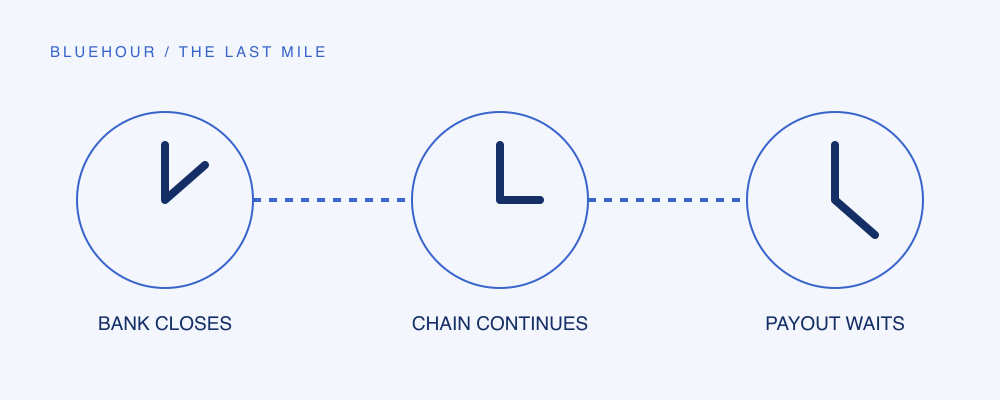
The internet has taught us to expect availability. A message sent at midnight does not ask whether the recipient’s city is still inside banking hours. Money crosses the same time zones, but it travels through systems with different clocks. An always-on settlement rail can meet a local payout window that has already closed.
BlueHour begins in that interval. The name describes a moment between day and night, when one place is winding down and another is beginning. For cross-border payments, this is not just an atmospheric detail. Operating windows shape what can happen next, how long a handoff may wait and when a recipient can actually use the money.
A blockchain can continue processing while a destination bank is closed. That is a useful capability, but it is not the same as continuous end-to-end payout. Funding, currency conversion and local delivery may depend on different participants. Each participant can have its own availability, liquidity requirements and process for recognizing that the previous leg is complete.
The temptation is to compress all of this into a single claim about settlement speed. That makes a website easier to scan. It can also erase the part of the journey that matters most to the person being paid. A transfer completed on one rail is progress; it is not evidence that every remaining dependency has been resolved.
This distinction belongs in the design itself. A route should communicate its stages without turning an illustration into a transaction history. A calculation should state the meaning of its inputs. A wallet should display its actual network, even when that network differs from the one a project prefers. These small choices determine whether a user is learning something or merely watching reassurance.
Crypto’s always-on culture has a real contribution to make here. It challenges the assumption that every financial process must inherit the same working day. But the useful version of that challenge pays attention to the last mile. Moving the middle leg outside office hours helps most when the rest of the route is coordinated to make use of that freedom.
BlueHour explores FX and stablecoin settlement through this view of time. The visual language pairs continuous paths with local clocks. The currency references help explain the places where conversion may enter a route; they do not announce live coverage. The concept is about making dependencies legible before attaching operational claims to them.
Connecting a wallet remains a separate choice. It lets the user view a real abbreviated address and the wallet’s current network. It does not sign a login message, initiate a transfer or create authority to spend assets. A visitor can skip that step and continue exploring the mechanism.
The promise worth working toward is not that every payment is instant everywhere. It is that the whole journey can become more coherent: fewer unexplained waits, clearer boundaries between stages and better coordination across different clocks. A network staying awake is only the beginning. The harder design question is what must stay connected for money to finish its journey.